
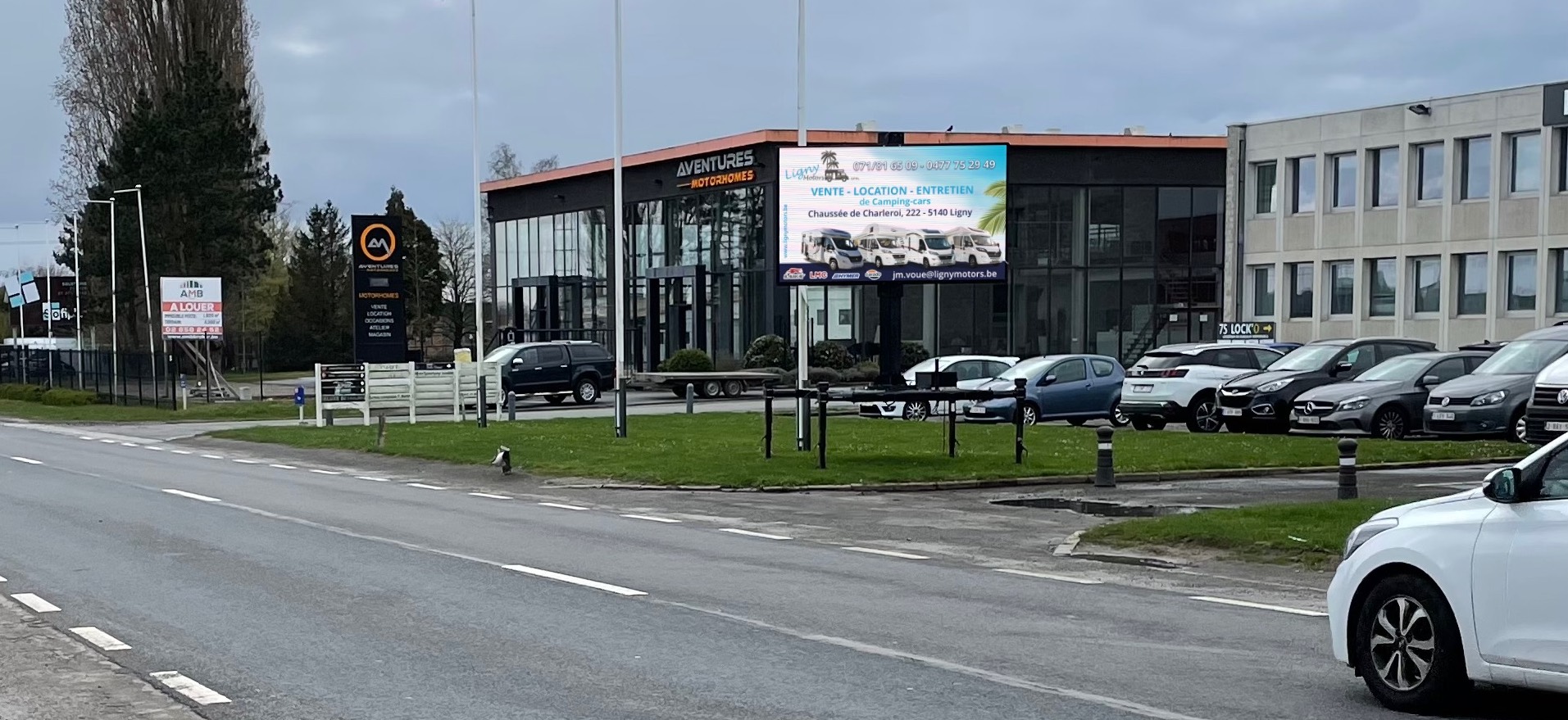
Frequently asked questions about LED screens? Here are the answers!
Does the LED screen work in direct sunlight?
Yes, each of our LED screens is equipped with a light sensor. This sensor adjusts the brightness of the screen according to the amount of sunlight outside. In direct sunlight, it will operate at full power; at night, it will operate at a lower level so as not to dazzle the public.
From what distance is the image on an LED screen clearly visible?
All our screens are equipped with LEDs with a pixel pitch of between 3.9 mm and 4.8 mm. This means that you need to be 4 to 5 metres away to see the image clearly.
Can a screen be installed on four legs or on a trailer on any surface?
- In general, screens on legs or trailers are installed on hard surfaces such as asphalt, clinker or dolomite that can support a minimum weight of 1 tonne, depending on the size of the screen.
- During the summer, we can install this type of screen on dry grass.
- However, depending on your needs, it is possible to install these screens on grass or even in a field using suitable 4×4 equipment.
What accessories can be hired?
- We can install a sound system of your choice, depending on the size of your audience.
- We can provide generators for locations with little or no electricity supply.
- We have various systems for transmitting video signals to screens.
- We can capture images and transmit them instantly to LED screens.
What kind of power supply do you need?
- For screens smaller than or equal to 7m2, a standard 220 V – 16 A power supply is suitable.
- For larger screens, you will need either several 220 V – 16 A lines or a 380 V – 32 A power supply.
Do I need extension cables?
MEDIALED will provide additional extension cables if necessary. However, a screen cannot be installed more than 100 m away from an electrical outlet.
How much power does an LED screen consume?
The actual power consumption of an LED screen varies and depends on the content being displayed. A white image will consume more power than a black image. However, it can be estimated that an LED screen consumes an average of 250 watts per hour.
In addition, a screen operating in direct sunlight will consume more electricity than a screen operating at night.
How long does it take to install a screen?
A screen can be installed within hours of your request. However, it is recommended that you plan your screen rental a week in advance to ensure that the screen is available and that a technician can install it on the desired date.
Is it possible to install or dismantle a screen during weekends or public holidays?
Yes, that is possible. However, we prefer to install the screen on Friday and dismantle it on Monday.
How is a screen transported?
MEDIALED transports the screens because outdoor screens weigh over a tonne.
Transport costs are calculated from our warehouse in Gembloux. The total distance is calculated by multiplying the distance between our warehouse and your location by 4. This is because our technician has to make two return trips: one to install the screen and one to dismantle it. This total distance is multiplied by a price per kilometre.
A van with a flatbed transports our screens measuring 6m² and above, or a vehicle tows trailers weighing less than 3.5 tonnes.
How long does it take to assemble and dismantle an LED screen?
- The time required to assemble or dismantle screens on stands or trailers is generally around one hour and is included in the hire price.
- However, for the hire of modular screens on a truss or layer structure, a minimum of 2 hours of assembly time for 2 technicians should be allowed. This assembly and dismantling time is not included in the hire price and depends on the size of the screen.
Can I operate the screen myself?
Yes, our technicians can explain the basic operation of the screen so that you can use it without assistance during the rental period.
Is the LED screen insured?
Yes, our screens are covered by insurance. However, the hirer must take care of the hired equipment with due diligence.
Do you still have questions about LED screens?